

Make: TAYLOR
Model: TXH350L
Year: 2016


Make: Manitou
Model: 48" Forks
Year: 2012

Make: JLG
Model: Truss Jib 12'
Year: 2011

Make: Capacity
Model: TJ5000 DOT
Year: 2010

Make: JLG
Model: 450AJ
Year: 2016

Make: FrostFighter
Model: IDF350
Year: 2015
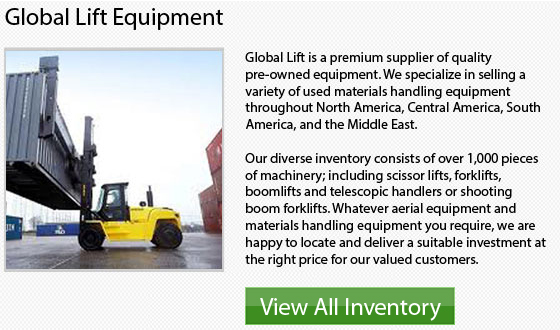
Hyundai Dual Fuel Forklifts Austin
Forklifts
Forklifts are used to transport, lift and engage palletized loads in material handling, construction, warehousing and manufacturing applications. With manual-drive forklifts, the load or travel movement is either powered manually or walk-behind. Motorized drive forklifts have a motorized drive. In numerous models, the forklift has a protected seat or cab for the operator. Fork trucks have features such as cabs, and backup alarms and are also motorized. Several models of forklifts are counterbalanced in order to prevent the vehicle from turning over. Other models are offered with safety rails, or a rotating element such as a hand rail or a turntable.
The stroke and lift capacity are other specification that you should take into consideration when selecting a kind of forklift. Lift capacity is defined as the supportable, maximum force or load. Stroke is defined as the difference between completely raised and fully lowered lift positions.
The type of fuel and the type of tire are also other key specifications which must be considered. The available fuel choices are: natural gas, liquid propane or LP, compressed natural gas or CNG, electricity, diesel, gasoline or propane.
There are two basic types of tires utilized for forklifts and fork trucks: solid and pneumatic. The solid or cushion tires need less maintenance than pneumatic tires and do not puncture easily. Pneumatic or air-inflated tires offer load cushioning and great drive traction. At the end of the day, cushion or solid tires offer less shock absorption.
Class VII forklifts are usually designed to be used on rough terrain. These types of machinery are normally used in construction, agriculture and in logging environments. Lastly, Class VIII forklifts have all personnel and burden carriers. Dual Fuel lift trucks often fit in this class.
- Nissan Double Reach Forklifts Austin
Narrow aisle trucks or reach trucks have become more common due to their ability to lessen their aisle count and floor space needs. These types of machinery have a trade-off; the need is for highly... More - Genie Aerial Lifts Austin
The Genie AWP Super Series aerial work platforms are a top favorite in the business because of their ease of use, flexibility and convenience. Their tough design and lightweight maneuverability make them an extremely versatile... More - Caterpillar High Capacity Forklifts Austin
Forklift Motors Purchasing a forklift is not to be taken lightly. A forklift is a big capital expenditure, and a complex machinery with a motor strong enough to perform heavy-lifting jobs. The price tag for... More - Raymond Double Reach Forklifts Austin
Raymond offers excellent forklifts and attachments specifically designed for the food processing industry. This business is amongst the busiest industries within our current world's infrastructure. To be able to handle the diversity in the food... More - Yale Narrow Reach Forklifts Austin
Yale offers a variety of very narrow aisle forklifts that are particularly engineered for utmost storage density. These very narrow aisle forklift are suitable for case picking and pallet handling in applicants ranging from 16... More