

Make: TAYLOR
Model: TXH350L
Year: 2016


Make: Manitou
Model: 48" Forks
Year: 2012

Make: JLG
Model: Truss Jib 12'
Year: 2011

Make: Capacity
Model: TJ5000 DOT
Year: 2010

Make: JLG
Model: 450AJ
Year: 2016

Make: FrostFighter
Model: IDF350
Year: 2015
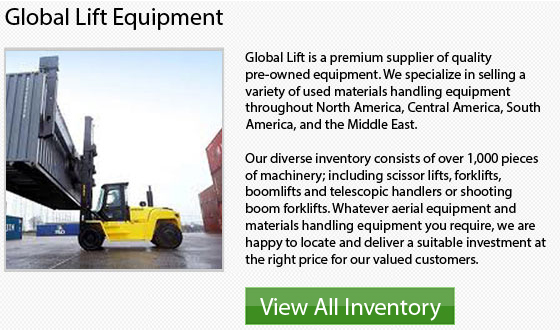
Caterpillar Propane Forklifts Austin
There are some disadvantages and advantages to both internal combustion (IC) and electric trucks.
Electric engines require less maintenance, and hence they cost less to maintain over their lifetime. The battery should last at least five years if the manufacturer's maintenance and charging guidelines are followed. Expenses for overnight charging are usually low. Electric trucks tend to be compact units and highly maneuverable, especially the types with three wheels. Drive, tilt, lift, acceleration and auxiliary speeds are adaptable and could be changed depending on the preferences of the driver and the application. Electric trucks are easier on the environment and are not noisy.
Not suitable to be used in wet conditions are electric trucks. Due to the need for battery recharging, they cannot be constantly utilized. They are not suitable on rough terrain. The energy consumption is high on ramp work and continuous high lifts.
IC engine diesel/LPG has the advantage of being suitable for continuous outdoor application and uneven surfaces. With no requirement for battery charging, the forklift can be utilized throughout the evening and overnight. Supply and transport of fuel needs to be factored into expenses. Initial costs are less than for an electric truck, but long term costs related to fuel and maintenance are higher. IC engines have bigger capacities than electric, but less adaptability. LPG can be used in several indoor applications. IC Engine diesel/LPG produces higher emissions and more noise compared to electric. LPG has lower emissions than diesel.
- Nissan Double Reach Forklifts Austin
Narrow aisle trucks or reach trucks have become more common due to their ability to lessen their aisle count and floor space needs. These types of machinery have a trade-off; the need is for highly... More - Genie Aerial Lifts Austin
The Genie AWP Super Series aerial work platforms are a top favorite in the business because of their ease of use, flexibility and convenience. Their tough design and lightweight maneuverability make them an extremely versatile... More - Caterpillar High Capacity Forklifts Austin
Forklift Motors Purchasing a forklift is not to be taken lightly. A forklift is a big capital expenditure, and a complex machinery with a motor strong enough to perform heavy-lifting jobs. The price tag for... More - Raymond Double Reach Forklifts Austin
Raymond offers excellent forklifts and attachments specifically designed for the food processing industry. This business is amongst the busiest industries within our current world's infrastructure. To be able to handle the diversity in the food... More - Genie Boom Lifts Austin
There are truly many reasons to pick Genie for your lift equipment needs. Genie provides top-of-the-industry items, support, and service to help you with all of your equipment needs. Genie is committed to making your... More