

Make: TAYLOR
Model: TXH350L
Year: 2016


Make: Manitou
Model: 48" Forks
Year: 2012

Make: JLG
Model: Truss Jib 12'
Year: 2011

Make: Capacity
Model: TJ5000 DOT
Year: 2010

Make: JLG
Model: 450AJ
Year: 2016

Make: FrostFighter
Model: IDF350
Year: 2015
CAT Telescopic Forklifts Austin
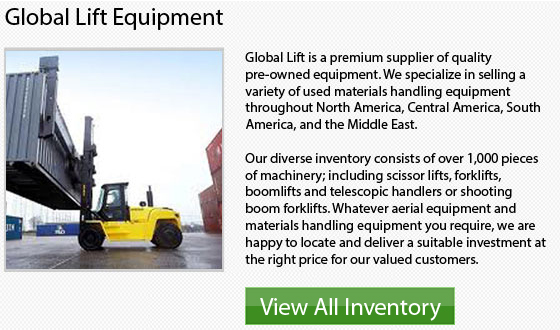
The telehandler or telescopic handler is a heavy duty machine that is well-known within both the construction and agriculture industries. These machines are quite similar in both appearance and function to the lift truck, except it more closely resembles a crane. The telehandler offers improved versatility of a single telescopic boom which could extend upwards as well as forwards from the vehicle. The operator can connect many attachments on the end of the boom. Some of the most common attachments include: a muck grab, a bucket, a lift table or pallet forks.
A telehandler usually utilizes pallet forks as their most common attachment to be able to move cargo through locations which are usually unreachable for a standard forklift. Like for example, telehandlers can move loads to and from areas which are not typically accessible by standard forklift models. These devices also have the ability to remove palletized loads from within a trailer and place these loads in high places, such as on rooftops for example. Before, this situation mentioned above will need a crane. Cranes can be expensive to use and not always a practical or time-efficient choice.
Telehandler's are unique in that their advantage is also their largest limitation: since the boom extends or raises when the machinery is bearing a load, it also acts as a lever and causes the vehicle to become quite unstable, even with the rear counterweights. This translates to the lifting capacity decreasing fast as the working radius increases. The working radius is the distance between the center of the load and the front of the wheels.
For example, a vehicle which has a 5000 pound capacity with the boom retracted might be able to safely raise just as heavy as 400 pounds when it is completely extended with a low boom angle. The same unit with a 5000 lb. lift capacity that has the boom retracted might be able to easily support as much as 10,000 pounds with the boom raised up to 70.
The Matbro Company within Horley, Surrey, England first pioneered telehandlers. These machinery were developed from their articulated cross country forestry forklifts. Initially, they had a centrally mounted boom design on the front section. This placed the driver's cab on the equipment's back portion, like in the Teleram 40 model. The rigid chassis design with the cab located on the side and a rear mounted boom has ever since become increasingly more popular.
- Nissan Double Reach Forklifts Austin
Narrow aisle trucks or reach trucks have become more common due to their ability to lessen their aisle count and floor space needs. These types of machinery have a trade-off; the need is for highly... More - Genie Aerial Lifts Austin
The Genie AWP Super Series aerial work platforms are a top favorite in the business because of their ease of use, flexibility and convenience. Their tough design and lightweight maneuverability make them an extremely versatile... More - Caterpillar High Capacity Forklifts Austin
Forklift Motors Purchasing a forklift is not to be taken lightly. A forklift is a big capital expenditure, and a complex machinery with a motor strong enough to perform heavy-lifting jobs. The price tag for... More - Genie Straight Manlifts Austin
The company introduced the innovative, portable pneumatic material lift, the Genie Hoist, at the start of Genie Industries' history in the year 1966. To offer its clients the best, Genie continued to develop fast and... More - Genie Boom Lifts Austin
There are truly many reasons to pick Genie for your lift equipment needs. Genie provides top-of-the-industry items, support, and service to help you with all of your equipment needs. Genie is committed to making your... More