

Make: TAYLOR
Model: TXH350L
Year: 2016


Make: Manitou
Model: 48" Forks
Year: 2012

Make: JLG
Model: Truss Jib 12'
Year: 2011

Make: Capacity
Model: TJ5000 DOT
Year: 2010

Make: JLG
Model: 450AJ
Year: 2016

Make: FrostFighter
Model: IDF350
Year: 2015
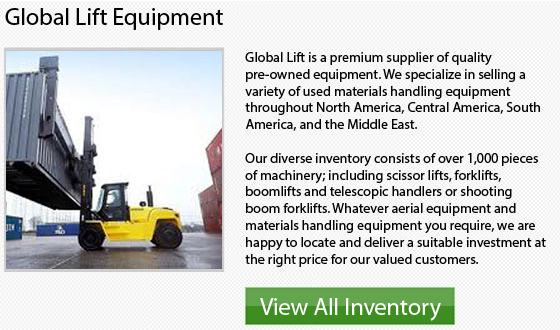
Komatsu Diesel Forklift Austin
Lift trucks are utilized to raise, engage and transport palletized loads in warehousing, manufacturing, material handling, mining and construction applications. There are 3 main kinds of lift trucks: a manual drive, motorized drive and fork truck. The travel or load movement is powered manually or by walking behind the machinery with manual-drive lift trucks.
Motorized-drive model forklifts are complete with a motorized drive. In many instances, a protected cab or seat is part of the design to keep the operator safe and comfortable. Fork trucks are another type that are motorized and comprise features like for instance backup alarms and cabs. In order to prevent the machine from tipping over, several forklifts are counterbalanced. Other models comprise safety rails, a rotating element like for instance a turntable or different kinds of hand rails.
Essential specifications to take into consideration when choosing lift trucks include lift capacity and stroke. Stroke is defined as the difference between the fully-raised and the fully-lowered lift positions. Lift capacity is the maximum, supportable load or forcforce or load. Additional specifications for lift trucks comprise their type of fuel and tire.
Forklifts include various fuel options like: liquid propane or LPG, CNG or compressed natural gas, propane, diesel fuel, gasoline and natural gas. There are 2 basic types of tires utilized for operating fork trucks and forklifts: solid and pneumatic. Cushion or solid tires need less maintenance than pneumatic tires and do not puncture. The solid or cushion tires do provide less shock absorption overall. Air-inflated or pneumatic tires on the other hand provide excellent load-cushioning and drive traction.
There are 7 classes of forklifts. The first class of forklifts, Class I, is either stand-up or seated 3 wheeled units which are electric-motor rider trucks. Usually, rider units may have either cushion or pneumatic wheels and are counterbalanced. Class II lift trucks are electric motor units which are used for order picking or stock applications in narrow aisle setting. These models provide extra reach functions or swing mast.
Forklift Class III lift trucks consist of walk-behind or standing-rider operated electric-motor trucks. High lift models and automated pallet lift trucks are usually counterbalanced units. Class IV lift trucks have cabs and seated controls. These kinds of forklifts are rider fork trucks with IC or internal combustion engines. Moreover, this class uses cushion or solid tires.
Rider fork Trucks are included in Class V. These machinery will have cabs and seated controls, pneumatic tires and internal combustion or IC engines. Like Class IV lift trucks, they are typically counterbalanced. Class VI lift trucks are tow tractor lifts that are designed for a sit-down rider. This particular class is supplied with internal combustion or IC or electric engines.
Class VII lift trucks are the last classification and consist of rough terrain forklifts, which are commonly used in construction, logging and agricultural applications. Class VII forklifts include all personnel carriers and burden carriers.
- Nissan Double Reach Forklifts Austin
Narrow aisle trucks or reach trucks have become more common due to their ability to lessen their aisle count and floor space needs. These types of machinery have a trade-off; the need is for highly... More - Jungheinrich End Control Forklifts Austin
The lift truck is a vital machinery to help workers lift and move heavy weight supplies and products with speed and efficiency without straining their bodies. The way a company uses this machinery could considerably... More - Snorkel Articulated Boom Lift Austin
A-Series Articulating Boom Lifts The A-Series of articulating boom lifts by Snorkel dominate on the tougher job sites. These equipment combine remarkable maneuverability with precision and power. These machines are capable of reaching working heights... More - Genie Straight Manlifts Austin
The company introduced the innovative, portable pneumatic material lift, the Genie Hoist, at the start of Genie Industries' history in the year 1966. To offer its clients the best, Genie continued to develop fast and... More - Genie Boom Lifts Austin
There are truly many reasons to pick Genie for your lift equipment needs. Genie provides top-of-the-industry items, support, and service to help you with all of your equipment needs. Genie is committed to making your... More